Streamlined Liquidation Support for Businesses

Streamlined Liquidation Support for Businesses

Streamlined Liquidation Support for Businesses

In the dynamic and competitive business environment of the current day, a business may find itself at a point where it can no longer operate or do the same to serve its strategic objectives. Liquidation is a necessary measure, whether the financial restructuring, market changes, or some regulatory reasons are the motivation. It is in this area that Liquidation Services in Dubai becomes a very important factor with a much-needed solution of providing businesses with a methodical, legal, and practical conduit to legally put an end to business activities without jeopardizing stakeholder interests. Through the professional advice of experts like RBS Auditors, the foremost professional accounting and auditing company in the UAE, companies can sail through the liquidation process in a very confident and transparent manner.

Understanding Business Liquidation

Understanding Business Liquidation

Winding up a company. Business liquidation is the official procedure of a company. It entails the sale of assets, outstanding liabilities, settling up of employee dues, and legal deregistration of the business by the concerned authorities. Liquidation may be voluntary, through the process of shareholders or directors, or compulsory, caused by insolvency or a legal injunction. Liquidation in the UAE is a process that cannot be ignored in terms of legal, financial, and administrative procedures, so it is necessary to seek expert assistance.

Importance of Professional Liquidation Support

Ensuring Regulatory Compliance

The UAE boasts clear policies on company liquidation that vary depending on whether a company is located in the mainland or a free zone. Lack of a step or sending out wrong documentation may cause delays, fines, or subsequent litigation. Professional liquidated support is a guarantee that all the statutory obligations are carried out correctly and in due time, giving comfort to the business owners.

Streamlining a Complex Process

Liquidation is a process that encompasses several steps, such as shareholder resolutions, appointment of liquidators, publication of notices, approval of authorities, and ultimate deregistration. It may be hectic and stressful to handle these tasks without expert advice. Professional firms facilitate the whole process by liaising with authorities and stakeholders to facilitate smooth implementation of the entire process.

Accurate Financial Closure

Proper financial settlement is one of the most critical areas of liquidation. This involves the preparation of final accounts, the valuation of assets, the identification of liabilities, and the distribution of proceeds according to the appropriate legal order. By having skilled personnel, financial records are precise, transparent, and in accordance with accounting principles, minimizing the chances of disputes or subsequent claims.

Managing Stakeholder Communication

In the process of liquidation, it is essential to have straightforward communication with creditors, employees, shareholders, and authorities. Failure to handle this aspect may lead to misunderstandings or legal problems. The need to support the process with professional liquidation means that all parties are notified in a proper manner and treated fairly, with the process being professional.

Key Elements of Streamlined Liquidation Support

Initial Evaluation and Planning

The liquidation process starts with a close examination of the financial position of the company, assets, liabilities, and legal requirements. This analysis assists in identifying the most appropriate liquidation strategy and schedule so that the procedure is in line with the requirements of regulations and business facts.

Legal Documentation and Approvals

Liquidation is a process that entails a lot of documentation, whether it is the drafting of board resolutions or the statutory filing. Submissions to concerned authorities would be done by professionals who would make sure that the paperwork is correct and is submitted in compliance, thus saving time and waste.

Asset Valuation and Disposal

The company assets have to be recognized, appraised, and disposed of. This can be inventory, property, equipment, and intellectual property. The proper valuation means that the liabilities are settled in a fair manner, and it maximizes the value to the stakeholders.

Settlement of Liabilities

All outstanding debts, employee benefits, and other obligations should be paid off in accordance with the UAE laws. Professional advice will make sure that liabilities are appropriately prioritized and the directors and shareholders are not exposed to any legal liability.

Final Deregistration

After payment of all the requirements, the company is then deregistered by the authorities. This step should be completed correctly in order to close the business officially and avoid compliance issues in the future.

How RBS Auditors Add Value to the Liquidation Process

RBS Auditors is a professional accounting and auditing company in the UAE that provides complete financial and advisory services to companies based in different spheres. Their knowledge base in liquidation support helps businesses to be efficient and responsible in terms of closure.

Having a deep understanding of UAE regulations, RBS Auditors will help to facilitate the liquidation process end-to-end, starting with pre-planning to deregistration. They focus more on accuracy, transparency, and ethical conduct, which would provide their clients with quality guidance on the process. They enable business owners to concentrate on future opportunities without having any worries about complex financial and regulatory requirements.

Conclusion

Liquidation is one of the significant business lifecycle milestones that need to be planned, regulated, and executed by a professional. When liquidation services in Dubai are selected carefully, it is essential to make sure that everything is done efficiently, legally, and with little risk. Through the assistance of skilled individuals such as RBS Auditors, businesses are able to have an easy and guided closure at the expense of all the stakeholders. Liquidation support itself is a complicated process that can be simplified only by streamlining it, and the liquidation support is offering a responsible channel through which a business can end and continue its operations with confidence.

Author Bio

image

RBS Auditing is a leading professional accounting and auditing firm in the UAE, providing expert services in audit, tax, compliance, and financial advisory to help businesses succeed. With a dedicated team of
 

Your Guide to Easy Freezone Company Setup

Your Guide to Easy Freezone Company Setup

Your Guide to Easy Freezone Company Setup

The decision to establish a business in the UAE is a key move by businesspeople and investors aiming at expanding their business worldwide, taking advantage of tax benefits, and flexibility in their operations. UAE Freezone Company Formation is one of the most demanded ones, as it has a simplified process of setup and gives appealing incentives to foreign investors. The free zones are structured to promote international business, which is why it are perfect in the case of startups, SMEs, and even multinational companies. This is a guide describing the advantages, procedures, and most important things to consider when setting up an easy freezone company, and the importance of having RBS Auditors, a popular professional auditing and accounting company in the UAE, to make the journey easy and compliant.

Understanding UAE Free Zones

UAE free zones are economic zones that are created to stimulate foreign investment and international trade. The free zones are managed by individual regulatory bodies and serve particular business operations, including trading, consulting, logistics, manufacturing, media, or technology. The areas are business-friendly with limited restrictions and bureaucratic processes.

Among the key facts that lead entrepreneurs to free zones, there is an option to keep all the rights of ownership over the company. Moreover, free zones have simplified the import and export process, advanced infrastructure, and easy access to the regional and international markets.

Key Benefits of Freezone Company Setup

The establishment of Freezone companies has several benefits that render it a desirable option to the investor:

100% Foreign Ownership

Free zone businesses enable the investor to enjoy full ownership of their business with no requirement of a local sponsor, which gives them complete control over the company and decision-making.

Tax Efficiency

Most of the free zones have corporate tax incentives and exemptions, and it is therefore a cost-efficient alternative to businesses that would like to maximize their profits.

Complete Repatriation of Profits

The owners of the business are able to repatriate 100 percent of their profits and capital without restrictions, and this is great in terms of international investors.

Easy and Fast Setup

The process of forming a free zone company is also simple compared to other jurisdictions, and in most cases, the process can be achieved within a limited period of time.

World-Class Infrastructure

Free zones have access to high-tech office spaces, warehouses, logistics, and digital infrastructure, which facilitate the development of a business.

Choosing the Right Free Zone

Choosing the Right Free ZoneThe UAE has a high number of free zones, all of which are meant to serve specific industries. The choice of the appropriate free zone is premised on the nature of your business operations, financial capacity, visa needs, and future growth strategies. There are those who are oriented towards trading and logistics, and others, towards professional services, media, technology, or industrial orientation.

It is necessary to pay attention to the evaluation since not all free zones are equal in terms of licensing fees, office prices, and the rules. With professional counselling, you will be able to select the most appropriate free zone depending on the objectives of your business.

Step-by-Step Process for Easy Freezone Company Setup

The following are some of the steps that are usually followed in establishing a freezone company:

1. Define Your Business Activity

Know what your business is doing, where this is, and which type of license you need and which free zone you would need to be in.

2. Select a Free Zone Authority

Select a free zone that fits your business activities and provides the opportunities you require.

3. Choose a Company Name

Choose a trade name that meets the naming laws of the UAE and is acceptable to the free zone authority.

4. Submit Required Documents

The usual documents are the passport copies of shareholders, application forms, and business details. Needs are subject to change depending on the free zone.

5. Obtain the Trade License

The free zone authority presents the trade license after the application has been approved and the fees paid.

6. Arrange Office or Flexi-Desk Space

The licensing process of most of the free zones will need a registered office address or a flexi-desk facility.

7. Open a Corporate Bank Account

You can use your incorporation and license documents to open a corporate bank account.

8. Apply for Visas

Your package will permit you to seek residence visas for shareholders and employees on the basis of your package.

Significance of Professional Support

Although freezone company establishment is expected to be an easy task, it may be challenging to work through the regulatory conditions, paperwork, and compliance. Here is a place where professional knowledge is most required.

RBS Auditors is a prestigious professional accounting and auditing company in the UAE that offers all-inclusive assistance to the establishment of free zone companies. They have an experienced team that helps businesses to register the company, do accounting and bookkeeping, provide advice on VAT and corporate tax, conduct statutory audits, and provide compliance maintenance needs. Having a deep insight into the regulations and the free zone authorities in the UAE, RBS Auditors will be able to assist in making sure that your business establishment is correct, efficient, and compliant.

Related Blog – Key Steps to Setting Up a Business in UAE Freezones

Post-Formation Compliance and Management

Once equipped, businesses will have to work on continuous compliance to ensure that operations proceed without any difficulties. This can be in the form of keeping good accounting records, renewing trade licenses, and responding to audit conditions, as well as tax regulations. The professional companies, such as RBS Auditors, can be an essential partner in performing these duties so that the business owners can work on development and planning.

Conclusion

UAE Freezone Company Formation is a good decision for entrepreneurs who are interested in an easy establishment process, tax efficiency, and access to the global market. Free zones still bring in investors throughout the world due to the distinct merits of one hundred percent ownership, easy processes, and the business-friendly atmosphere. With the proper guidance and the company set up done by the highly trained professionals, such as RBS Auditors, the largest professional auditing and accounting company in the UAE, a smooth, compliant, and successful freezone company formation is possible, which facilitates the growth of the business in the long term.

Author Bio

image

RBS Auditing is a leading professional accounting and auditing firm in the UAE, providing expert services in audit, tax, compliance, and financial advisory to help businesses succeed. With a dedicated team of experienced professionals, we’re committed to delivering reliable support and trusted insights for your financial needs.

Trusted Audit Experts Ensuring Full Compliance

Trusted Audit Experts Ensuring Full Compliance

Trusted Audit Experts Ensuring Full Compliance

In the modern business environment, which is very dynamic, financial discipline and regulatory adherence are not only good practice but also the key to long-term growth and integrity. In the case of businesses in dynamic markets, such as the United Arab Emirates, it is best to enlist the services of reputable audit firms in UAE, so that financial statements are not subject to scrutiny, the risks are well mitigated, and the governance frameworks are well established. Be it a start-up venturing into a new market or an already established business venturing into new ventures, professional assistance offered by auditors is vital in instilling confidence in its stakeholders, regulatory bodies, and financial institutions.

RBS Auditors is ranked among the respected companies within the region as one of the most reputable professional accounting and auditing firms in the UAE, as it provides complete solutions to keep businesses in compliance and enhance financial transparency and efficiency of operations.

Importance of Auditing in Modern Businesses

Importance of Auditing in Modern Businesses

Auditing is much more than a statutory requirement. It is a business tactic that ensures the financial sanity and integrity of an organization. A properly conducted audit has a number of objectives:

  • Financial Accuracy and Transparency: Independent audits confirm the accuracy of financial statements and their preparation as required by the accepted accounting standards. This disclosure enhances the stakeholder trust and helps in making well-informed decisions.
  • Regulatory Compliance: Companies that are located in the UAE are required to adhere to the changing laws like VAT and corporate taxation, Economic Substance Regulations, and the Anti-Money laundering rules. Professional audits will guarantee compliance with these rules and minimize the risk of punishment.
  • Risk Management and Fraud Detection: Auditors examine internal controls, determine weaknesses, and detect abnormalities or possible fraud. Their experience assists organizations in having more powerful control mechanisms.
  • Operational Improvement: Audits tend to demonstrate inefficiency in processes and systems, giving recommendations that are going to increase productivity and profitability.

All these benefits render professional auditing a pillar of the success of the business in the long run.

Role of Audit Firms in the UAE

Accountability and financial governance standards are very high in the UAE regulatory environment. Experienced audit companies serve as reliable business associates because of the variety of specialized services, such as:

  • Statutory Audits: to verify that the financial statements are in accordance with the requirements of the law and regulations.
  • Internal and Risk Audits: This is an assessment of internal systems to enhance internal controls and mitigate operational and financial risks.
  • Forensic Audits: Investigating financial differences, misconduct, or fraud.
  • Compliance Audits: The detection of compliance with VAT, corporate taxes, ESR, and AML.
  • Advisory Services: Moving business planning and sustainable growth with expert advice.

Through their provision of such services, audit professionals assist an organization to stay in compliance and also improve financial discipline in general.

RBS Auditors: A Trusted Name in Compliance and Assurance

RBS Auditors is one of the leading audit firms in the UAE, and it has been able to position itself as a reliable business partner providing accurate, compliant, and value audit solutions to firms. Being one of the most popular professional accounting and auditing companies in the UAE, the firm works with a wide range of clients within the various fields of operation.

What Distinguishes RBS Auditors

Comprehensive Service Offering

RBS Auditors is an end-to-end company that covers auditing, accounting, taxation, and advisory services. This combined business model enables customers to take care of all financial and compliance requirements under a single roof.

Experienced and Qualified Professionals

The collaborators of the firm are experienced professionals who have qualifications that are internationally accepted and a good understanding of local regulations. This combination will ensure that audits are done in accordance with the global standards and meet the UAE regulations to the letter.

Strong Regulatory Recognition

RBS Auditors is a company that is approved by different authorities and free zones, which demonstrates its credibility, reliability, and compliance with professional standards.

Client-Centric Approach

RBS Auditors recognize that all businesses are unique and therefore, the business audits are designed to satisfy the unique needs of the company and industry. Such individualized treatment will provide valuable insights, beyond compliance, which is pointless.

RBS Auditors, to the extent that it upholds accuracy, integrity, and professionalism, assists businesses in enhancing financial transparency and the confidence of its long-term stakeholders.

Suggested Blog – Choosing the Right Audit Firm in the UAE: Key Tips for 2026

Long-Term Benefits of Working with Audit Experts

Collaboration with seasoned audit practitioners is a source of sustained benefits that go beyond regulatory compliance, including:

  • Increased corporate accountability and governance.
  • Less financial and legal risks.
  • Better investor/ stakeholder confidence.
  • Higher quality strategic planning with sound financial data.

The benefits of the appropriate audit partner choice are presented here.

Conclusion

A competitive and highly regulated business environment implies that collaboration with the Trustworthy Audit Firms in the UAE is the key to full compliance, financial transparency, and further sustainable growth. Professional auditors would be crucial in safeguarding businesses against regulatory risks as well as improving their level of efficiency and credibility.

Being a top practice professional accounting and auditing company in the UAE, RBS Auditors still serves organizations with reliable audit, compliance, and advisory services that enable businesses to conduct operations with ease and clarity.

Author Bio

image

RBS Auditing is a leading professional accounting and auditing firm in the UAE, providing expert services in audit, tax, compliance, and financial advisory to help businesses succeed. With a dedicated team of experienced professionals, we’re committed to delivering reliable support and trusted insights for your financial needs.

UAE VAT Profit Margin Scheme 2026: VATGPM1 Changes the Rules — Are You Still Compliant?

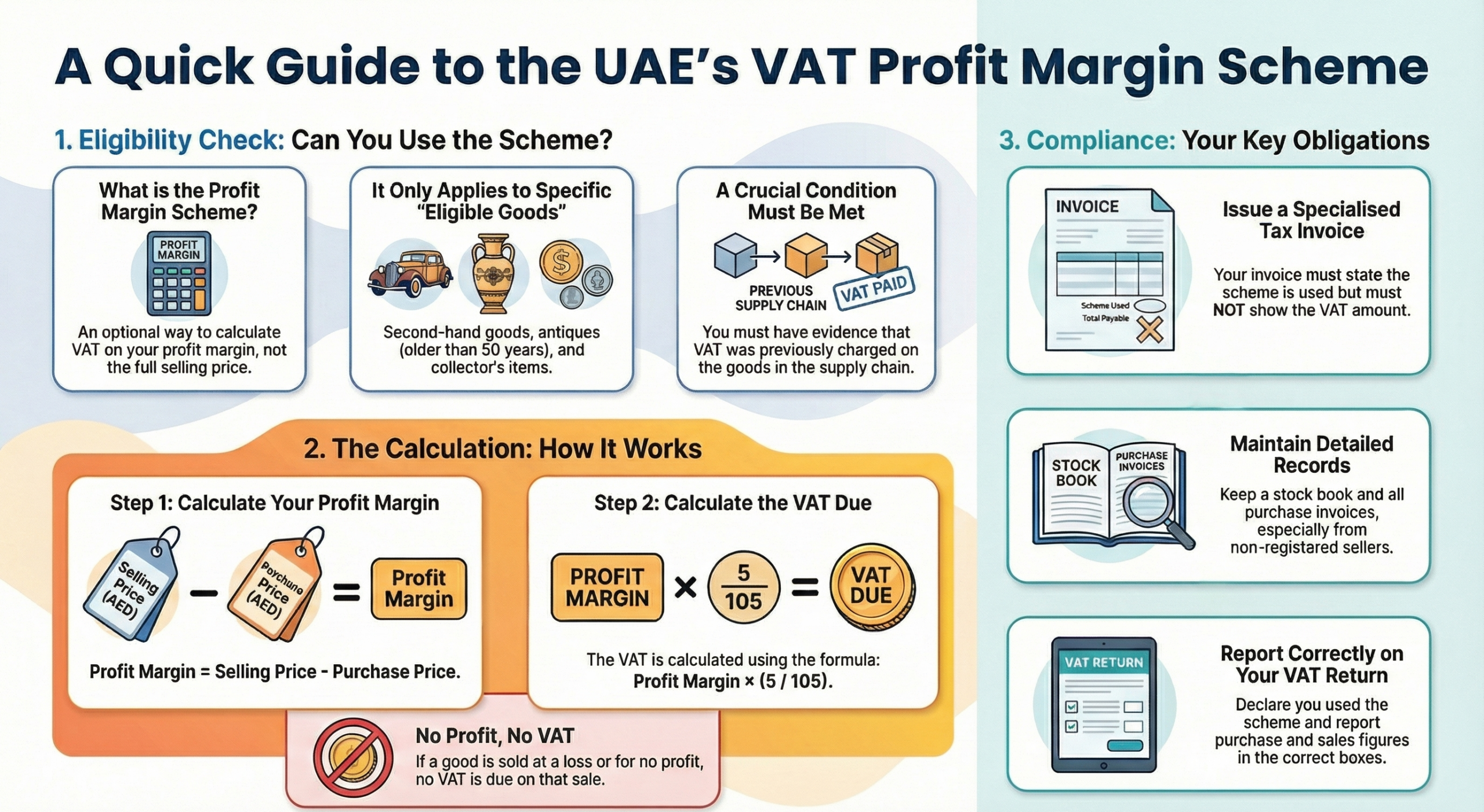
UAE VAT Profit Margin Scheme 2026 infographic showing eligibility check, calculation steps, and compliance obligations for VATGPM1EXECUTIVE SUMMARY

The Federal Tax Authority has released its first comprehensive guide on the Profit Margin Scheme (VATGPM1), effective January 2026. This optional mechanism allows VAT-registered resellers to account for VAT on the profit margin rather than the full selling price for eligible goods—eliminating VAT cascading on second-hand goods, antiques, and collector’s items.

Scope & Eligibility

The scheme applies to the resale of second-hand goods, antiques (over 50 years), collector’s items, and certain Article 53 goods where input VAT recovery was blocked. Eligibility is strictly limited to goods that were previously subject to VAT, typically acquired from non-registrants or suppliers applying the scheme.

Eligible Goods (Three Categories)

Article content

Mechanism & VAT Computation

VAT under the scheme is calculated only on the profit margin, using the 5/105 fraction, treating the margin as VAT-inclusive. Each transaction is assessed independently, and loss-making or break-even sales do not attract VAT, with no cross-offset of losses permitted.

Critical Implications:

Article content

Background & Regulatory context

Legislative Framework

Article content
Profit Margin Scheme

What’s New?

This is not a legislative amendment—Article 29 has existed since 2017. However, until now:

• No consolidated FTA guidance on practical application

• Ambiguity on record-keeping standards for purchases from non-registrants

• Unclear VAT return reporting methodology for loss-making transactions

• Limited clarity on Article 53 Goods eligibility (blocked input tax scenarios)

VATGPM1 provides:

✓ Step-by-step calculation methodology

✓ Definitive invoicing and record-keeping requirements

✓ VAT return box-by-box reporting instructions

✓ 12 worked examples covering edge cases

VAT Return Reporting

Registrants applying the scheme must explicitly elect the option in the VAT return and report selling prices and VAT amounts in the prescribed boxes. Purchase prices are reported separately without VAT, reinforcing transaction-level traceability.

Risk & Audit Implications

The guidance signals a clear shift toward evidence-based audits, with particular focus on eligibility proof, margin calculations, and invoice compliance. Errors may result in denial of the scheme and reassessment of VAT on the full selling price, along with applicable penalties.

PENALTIES & COMPLIANCE RISKS

While VATGPM1 does not specify scheme-specific penalties, standard VAT Law and Tax Procedures Law penalties apply:

Article content

CONCLUSION & STRATEGIC TAKEAWAYS

Key Insights

1. Clarification, Not Change: VATGPM1 operationalizes existing law—no new tax burden, but compliance standards elevated.

2. Administrative Trade-Off: Tax savings (up to 52% in examples) offset by enhanced record-keeping—viable only with robust systems.

3. Evidence is King: No documentary proof of prior VAT = No Scheme—this will be FTA’s primary audit focus.

4. Loss Treatment: Cannot pool profits/losses across transactions—each good is a separate supply for VAT purposes.

5. Invoice Discipline: Issuing a tax invoice showing VAT amount irreversibly forfeits Scheme election for that transaction.

Recommended Position

✅ ADOPT SCHEME IF:

• ≥60% purchases from non-registrants

• Positive contribution margin per transaction

• ERP capable of dual-stream inventory tracking

• Strong document retention culture

❌ REJECT SCHEME IF:

• Unable to evidence pre-2018 acquisitions

• Import-reliant model (input tax benefit lost)

• Administrative cost exceeds tax savings

• High audit risk tolerance threshold

Disclaimer

This newsletter is intended solely for general informational and educational purposes. It summarises the Federal Tax Authority’s VAT Guide on the Profit Margin Scheme (VATGPM1 – January 2026) and the applicable provisions of UAE VAT legislation as in force at the date of publication. It does not constitute legal, tax, accounting, or professional advice, nor should it be relied upon as such.

The application of the UAE VAT Profit Margin Scheme depends on the specific facts, circumstances, and documentation of each transaction. Tax positions may vary based on interpretation, subsequent guidance issued by the Federal Tax Authority, or changes in law and practice. Readers are advised to obtain independent professional advice before implementing the Profit Margin Scheme or taking any action based on the contents of this article.

Neither the author nor the firm accepts any responsibility or liability for any loss arising from reliance on this publication without appropriate professional consultation.

#UAEVAT #ProfitMarginScheme #VATGPM1 #UAETaxUpdates #VATCompliance #FTAGuidance #AuditAndTax #TaxNewsletter #UsedGoodsVAT


Subscribe to Audit & Tax News

Get trusted audit, tax, and business updates, fraud alerts, and industry insights—delivered biweekly for decision-makers.

Subscribe now: https://www.linkedin.com/newsletters/audit-tax-news-7396135073022103553/

Professional Accounting Solutions for Every Business

Professional Accounting Solutions for Every Business

Professional Accounting Solutions for Every Business

Financial accuracy and compliance are no longer a choice in the modern, dynamic business world that is highly regulated, but rather a necessity. Whether it is a small business or a large corporation, any company that is willing to operate is in need of a well-organized financial structure in order to be stable and to grow in the long run. Professional accounting solutions are very crucial in this. Working with reputed Accounting Firms in Dubai, companies, especially those that operate in the UAE, find it easy to do their operations as these firms know the local regulations, tax structure, and reporting structure. RBS Auditors is one of them and is commonly known as a reputable professional accounting and auditing firm in the UAE with a stable and comprehensive financial service to businesses in all industries.

The Importance of Professional Accounting Services

Accounting is not just a matter of basic bookkeeping. It offers a sound financial base, which helps to make informed decisions, comply with regulations, and efficiently operate. Proper accounting ensures that all economic activities are documented in an appropriate manner, categorized, and reported in the right way to enable the owner of the business to know their financial status at any particular time.

The UAE is a country that requires businesses to operate in accordance with the changing financial policies, such as VAT and corporate tax policies. Professional accountants keep abreast of such changes and keep the companies in line so that penalties and legal complications are minimized. This expertise is hard to obtain without the help of a special accountant.

Supporting Business Growth and Efficiency

Professional Accounting Solutions for Every Business 1

Among the key benefits of outsourcing accounting services is that it is possible to concentrate on the core business activities. Account management may be time-consuming and resource-intensive, especially when it is in-house, especially for small and medium-sized companies. Professional accounting solutions assist in streamlining the financial processes, enhancing efficiency, and reducing controls.

Increased financial reporting and access to real-time insights enable companies to know areas of growth, balance costs, and make future investments. Proper financial information is also an important factor in applying for funding or obtaining investors, as it shows financial discipline and transparency.

Key Accounting and Auditing Services for Businesses

Professional accounting firms are known to provide a variety of services that are meant to cater to various business needs. Such services typically involve bookkeeping, tax compliance, audit, payroll, and business advisory.

Bookkeeping and Financial Reporting

Regular bookkeeping, all the income and expenses are correctly recorded. This makes the foundation of key financial reports like profit and loss account, balance sheets, and cash flow statements. These reports assist business owners in monitoring the performance and making data-driven decisions.

Tax Planning and Compliance

One of the most important facets of financial management is compliance with tax. Professional accountants assist businesses in fulfilling VAT and corporate tax liabilities, besides discovering legal tax-saving opportunities. Effective tax planning not only makes sure that no laws are broken but also makes the funding of the business more manageable.

Auditing Services

Auditing is a third-party evaluation of financial documentation and internal controls of a company. It improves credibility, risk identification, and transparency. Forensic audits, internal audits, and statutory audits are helpful in ensuring that the business has financial integrity as well as building a trustworthy reputation with stakeholders.

Payroll Management

Payroll management needs to be precise and in line with labor legislation. Accounting firms are professionals in the management of salaries as they take care of the payroll processing, employee deductions, and statutory reporting, thus managing the wages on time and error-free.

Business Advisory Services

Other than the routine accounting, professional firms provide strategic planning in how to organize the business, expansion, financial forecasting, and risk management. This advisory position becomes a very important value addition in that it aligns the financial strategies to the business’s long-term objectives.

RBS Auditors – A Trusted Accounting Partner in the UAE

RBS Auditors is a reputable brand in professional accounting and auditing services in the UAE. Having a high degree of accuracy, compliance, and client-centric solutions, the firm serves companies in different industries. They have a team of skilled accountants and auditors who have vast experience in dealing with complicated financial needs, with strict compliance with the UAE regulations.

RBS Auditors has end-to-end services such as accounting and bookkeeping, auditing, tax advisory, payroll services, and business consulting. Their strategy is technical skills and customer service, which assists businesses in tightening the financial controls and creating more efficient operations.

Also Read –How Dubai’s Accounting Firms Power Business Growth?

Choosing the Right Accounting Firm

Choosing the proper accounting partner is a strategic process that can lead to significant effects on the success of a business. Industry experience, scope of services, professional qualifications, and the capacity of the firm to provide customized solutions are some of the factors that should be considered by businesses. Transparent communication and a proactive attitude are also some features that an accounting firm should have to be reliable.

The collaboration with more seasoned professionals means that the financial issues will be resolved as soon as possible, and the opportunities will be detected on time. This partnership will enable businesses to work with certainty and clarity in a market that has become very competitive.

Conclusion

The need for professional accounting solutions depends on the financial health and compliance, as well as the sustainable development. In the UAE, collaborating with already established Accounting Firms in Dubai is a way of accessing expertise, accuracy, and strategic financial advice to businesses operating in the UAE. Being one of the most recognized professional accounting and auditing firms in the UAE, RBS Auditors provides thorough solutions that would allow companies to put the complexities of finances behind them and concentrate on growth and the triumph of the business in the long term.

Author Bio

image

RBS Auditing is a leading professional accounting and auditing firm in the UAE, providing expert services in audit, tax, compliance, and financial advisory to help businesses succeed. With a dedicated team of experienced professionals, we’re committed to delivering reliable support and trusted insights for your financial needs.


Is Managerial Remuneration Paid to Connected Persons Deductible under UAE Corporate Tax?

Managerial remuneration paid to connected persons under UAE Corporate Tax

Executive Summary

As UAE businesses navigate the Corporate Tax regime, one area that demands urgent attention is payments to Connected Persons. The Federal Tax Authority (FTA) is increasingly scrutinizing these transactions, and non-compliance can result in denied deductions, penalties, and potential double taxation.

In this article, we break down the Connected Person provisions under Article 36 of the UAE Corporate Tax Law and provide actionable guidance to ensure your business remains compliant.

WHO IS A CONNECTED PERSON?

Under Article 36 of Federal Decree-Law No. 47 of 2022, a Connected Person is defined more broadly than traditional related parties to prevent profit shifting in the absence of personal income tax:

  • Owners/Shareholders of the taxable entity
  • Directors and Officers (including Managing Directors of LLCs)
  • Related Parties of the above (extended to fourth degree of kinship)

Why the strict definition?
In the absence of personal income tax in the UAE, there’s a risk that business owners might reduce corporate tax liability by inflating payments to themselves or related individuals. The FTA has implemented these rules to prevent profit shifting and maintain the integrity of the corporate tax base.

WHICH PAYMENTS ARE COVERED?

The Connected Person rules apply to a broad range of payments and benefits, including:

  • Salaries and bonuses
  • Directors’ fees and remuneration
  • Consultancy and professional fees
  • Rent for property
  • Interest on loans
  • Management and service fees
  • Benefits-in-kind (housing, vehicles, etc.)

THE TWO CRITICAL CONDITIONS FOR DEDUCTIBILITY

For any payment to a Connected Person to be tax-deductible, it must satisfy BOTH conditions under Article 36(1):

Condition 1: Market Value Requirement

The payment must reflect the market value of services or benefits provided, determined using the Arm’s Length Principle (ALP). This means the price should be the same as if you were dealing with an unrelated third party under similar circumstances.

Condition 2: Business Purpose Test

The expenditure must be:

  • Wholly and exclusively incurred for business purposes
  • Supported by a Need-Benefit Analysis
  • Not capital in nature

⚠️ CRITICAL WARNING: If these conditions are not met, the FTA will deny the deduction, increasing your taxable income and potentially triggering penalties.

TRANSFER PRICING METHODS

The UAE recognizes 5 OECD transfer pricing methods. For Connected Person compensation:

USE CUP (Comparable Uncontrolled Price) – the primary method that compares your payment with market rates for similar roles. Support it with TNMM (Transactional Net Margin Method), which verifies compensation is reasonable as a percentage of profit (typically 10-30% depending on industry).

CPM (Cost Plus Method) applies only to service fees from CP entities, not individual salaries.

RPM (Resale Price Method) never applies to remuneration – it’s for trading goods only.

PSM (Profit Split Method) is rarely used and only for partnerships with unique contributions.

Bottom line: Always use CUP as primary + TNMM as verification = strongest defense.

DISCLOSURE REQUIREMENTS & THRESHOLDS

Connected Person Schedule (Part of CT Return)

Threshold: Required when the aggregate value of transactions with a Connected Person exceeds AED 500,000 in the tax period.

Filing Timeline: Alongside the Corporate Tax return (within 9 months from the end of the tax period)

Transfer Pricing Documentation

Local File & Master File required when:

  • Your taxable revenue is AED 200 million or more, OR
  • You’re part of an MNE group with consolidated revenue of AED 3.15 billion or more

Submission: Within 30 days of FTA request.

CONCLUSION

Connected Person compliance under UAE Corporate Tax is mandatory, complex, and high-risk. The FTA’s intense focus on managerial remuneration means shareholder-executives and Key Management Personnel face the highest scrutiny.

Key Rules: All Connected Person payments must be at arm’s length – regardless of amount. Use CUP method for market benchmarking, verify with TNMM profit ratios, and document both contemporaneously. The AED 500,000 threshold triggers disclosure, not compliance.

Critical Action: Don’t wait for an FTA audit. Proactive compliance costs 70-85% less than post-audit remediation. Missing documentation, excessive compensation vs. profit, and lack of benchmarking are major red flags.

The Bottom Line: Prevention is cheaper than defense. Proper benchmarking now saves penalties, interest, and professional fees later.

📰 Read More on LinkedIn

For more insights on UAE Corporate Tax and audit updates, subscribe to our LinkedIn newsletter:

Read this article on LinkedIn

Audit & Tax News Newsletter


DISCLAIMER

This article is provided by RBS Ravis Auditors LLC for general information and educational purposes only. It does not constitute professional tax, legal, financial, or accounting advice tailored to your specific circumstances.

The information is based on UAE Federal Decree-Law No. 47 of 2022, related Cabinet Decisions, Federal Tax Authority guidance, and OECD Transfer Pricing Guidelines as of December 2024. Tax laws continue to evolve.

While every effort has been made to ensure accuracy, RBS Ravis Auditors LLC makes no warranties about completeness or suitability of this information. Consult qualified tax professionals before making decisions. We accept no liability for actions taken based on this content.

© 2025 RBS Auditors. All rights reserved.

What to Expect When Closing a Business in Dubai?

What to Expect When Closing a Business in Dubai?

What to Expect When Closing a Business in Dubai?

Closing a business in Dubai, either at will or due to uncontrollable factors, can be complex, with careful attention needing to be paid to all legal and financial considerations. A proper understanding of the steps involved and possible challenges you may face in the closure process will help you wade through the situation with much ease. This blog has been designed to give you an overview of what to expect while closing your business in Dubai and why professional help, such as the Services of Liquidation in Dubai, has a very significant role in ensuring a smooth-sailing process.

Understand the Legal Requirements

1. Understand the Legal Requirements

The first and foremost thing that needs consideration while planning to shut down a business in Dubai is the concept of law related to the business closure. The process, led by the Dubai Department of Economic Development (DED), includes several steps that must be followed carefully to avoid legal complications.

Regarding the business closure procedure, each free zone authority will have different methods that need to be followed by businesses set up in that free zone. It is essential to check with the relevant free zone authority or DED to determine how to finish all the paperwork.

2. Liquidation Process

Liquidation is a formal closure of the company, which consists of selling some or all of the company’s assets and using the proceeds to pay off debts. There are mainly two types: voluntary and involuntary.

  • Voluntary Liquidation: When a business owner wants to dissolve the business for personal or financial reasons, the appropriate process to follow is the voluntary liquidation. This process is usually initiated by the appointment of a liquidation company or professional firm, such as RBS Auditors, that specializes in liquidation services to oversee the process.
  • Involuntary liquidation: This takes place under conditions where a company is compelled either by law or due to insolvency issues to liquidate. Here, creditors may file petitions with the court to liquidate the company, and the process can be more complex.

Assets, like property and inventory, along with any other assets belonging to the company, are liquidated during liquidation, and debtors are paid from the proceeds of the sale. Any remaining funds after settlement of debts are then distributed to the shareholders.

3. Settlement of Company Liabilities

You need to settle liabilities that include loans, taxes, and employee salaries, among others; only then can you close a business in Dubai. This is an important step, considering the case where failure to settle liabilities may lead to legal action or penalties.

This process may involve:

  • Clearing Outstanding Debts: Paying off any business loans or financial obligations, including lines of credit and supplier invoices.
  • Employee Salaries and Benefits: Every employee has to be paid all dues, including gratuities or end-of-service benefits arising out of the UAE labor laws.
  • Clearance of Tax Liabilities: Any pending dues towards the government, such as VAT and corporate tax, must be cleared before proceeding to execute liquidation. It is also paramount that all the tax filings are current to avoid any potential penalties.

4. Deregistering with Relevant Authorities

After making the settlements of all your liabilities, the next step is to deregister the business with the relevant authorities. It basically means informing the DED, the UAE Federal Tax Authority, and any other regulatory body about your intention to close the business.

  • License Cancellation: The business license issued by DED or the relevant free zone authority has to be canceled. Business licenses of both onshore and offshore companies are required to be canceled.
  • Deregister for VAT: If your business was registered for VAT, it is a must to deregister with the FTA.
  • Terminate Sponsorships: In the case of foreign firms with local sponsors, cancellation of the sponsorship arrangement needs to be done prior to officially closing the business.

5. Closure Completed

Once all legal and financial obligations are met and the required registrations have been canceled, the formal closure of the business can occur. Now the company liquidation process may be considered completed, with a certificate of liquidation being issued. This certificate serves as proof of the successful closure of the company.

All closure documents should be kept on record, as they may be utilized for any future court or even financial issues.

Also Read – Why Choose Professional Liquidation Services Over DIY Liquidation?

6. Why Professional Assistance is needed

Business liquidation in Dubai is a demanding process for which professional advice is highly recommended. Liquidation services in Dubai, by expert auditors such as RBS Auditors, will make the entire process smooth. Professional knowledge of all legal and financial matters related to it helps them carry out the whole process of closing your business quickly and without any discrepancies.

RBS Auditors, being the leading professional service provider among all accounting, audit, tax, and advisory services in Dubai, Sharjah, and Abu Dhabi, can guide you through each step of the closure process, from liquidating assets to canceling registrations, making sure that all procedures are followed accurately.

Why Professional Assistance is needed

Conclusion

Business closure is a complex and time-consuming process, but with the right counsel and support, it can be completed with simplicity. Every step, from knowing the legal requirements to concluding the closure, is critical to the success of the business wind-up. Liquidation services in Dubai are necessary in order for your business closure to be done correctly and without any unnecessary complications. Experts like RBS Auditors can help you through the challenges brought about by the closure of your business so that you can continue with your next venture confidently.


What Sets Top Audit Firms Apart in the UAE?

What Sets Top Audit Firms Apart in the UAE?

What Sets Top Audit Firms Apart in the UAE?

Audit Firms in UAE play an indispensable role in ensuring corporate transparency, compliance, and financial integrity in today’s dynamic economic landscape. These firms are trusted partners that help businesses from startups to multinational corporations navigate through complex regulatory environments while fostering investor confidence. But the question is, what exactly sets apart the top-tier audit firms from the rest? In this blog, we discuss what distinguishes top audit firms of the UAE, with special focus on RBS Auditors, recognized as the leading professional service provider for all Accounting, Audit, Tax & Advisory Services in Dubai, Sharjah, and Abu Dhabi, UAE.

Strong Reputation and Local Expertise


1. Strong Reputation and Local Expertise

Among the foremost factors that set top audit firms apart in the UAE is their reputation. This standing in the market is built over years of consistent quality service, professional ethics, and successful client engagements. With deep-rooted local experience and a thorough understanding of the UAE’s regulatory environment on VAT, Corporate Tax requirements, and free zone compliance, the best firms provide audit solutions that are compliant and strategic.

RBS Auditors, for example, enjoys an excellent reputation within the UAE market since its incorporation in 2012. Founded by Sijin K Ravi, it has grown from a traditional accounting practice to a full-service professional services giant, serving clients in Dubai, Sharjah, and Abu Dhabi. With this local knowledge and insight, RBS Auditors has become known as one of the most trusted Audit Firms in the UAE for businesses of all sizes.

2. Full-Service Offerings

Top audit firms offer much more than just statutory audit reports and compliance checks. They provide a portfolio of services to a company’s broader financial health and business strategy needs. These range from internal audit and forensic audit to accounting, tax advisory, payroll services, business structuring, and economic consulting. Firms with such holistic capabilities act as strategic partners rather than compliance providers.

RBS Auditors is a good example of this trend through the provision of an integrated service portfolio that goes far beyond traditional auditing. Their services include statutory and internal audit, VAT and corporate tax advisory, accounting and bookkeeping, outsourcing, payroll management, and business support services. This full-service model enables clients to streamline their financial and compliance needs under one roof, ensuring consistency and quality at every level.

3. Conformity to International Standards

A typical attribute of top audit firms in the UAE is strict adherence to international auditing, such as IFRS or ISA standards. These standards are key to credibility — especially for those businesses with global stakeholders. This is so because they ensure that financial reports are transparent, comparable, and globally recognized.

Leading firms are also investing heavily in training and development to ensure that the audit teams keep up with evolving standards and best practices. The commitment to professional excellence follows through when an audit is conducted, not only to meet regulatory requirements but also to provide valuable insight into business performance, including areas of risk.

4. Qualified & Experienced Professionals

The quality of an audit firm is often reflected in the quality of its people. The best audit practices employ qualified professionals who, typically, boast respected qualification credentials such as ACCA, CPA, CFA, and industrious experience; sometimes Big Four backgrounds. Such qualifications assure clients that their financial statements will be reviewed and interpreted by the right experts, who identify even the most minute risks and great opportunities.

RBS Auditors boasts a team of qualified professionals equipped with both local market knowledge and international know-how. Their auditors have deep practical experience across sectors, thereby enabling them to cut through even the most intricate financial environments with precision and professionalism.

5. Technology and Innovation

The combination of innovative tools and technology has become the signature style of top audit firms across the world, and the UAE is no exception. Top firms have all utilized advanced audit software, cloud accounting platforms, and even artificial intelligence to achieve improved levels of accuracy, speed, and high data analytics when performing their audits. This technology-enabled approach creates stronger, more resilient audits that have the power to expose hidden risks and patterns.

Where some firms have focused on digital transformation at a very macro level, others blend technological adoption with personalized service to ensure the clients benefit from innovation, but not at the expense of the human touch. Increasingly, it is expected that a synergy between tech and expertise will guarantee businesses’ efficiency while availing bespoke advisory solutions.

Suggested Read – Why you must consult auditors and audit firms in UAE

6. Client-Centric Approach

Top audit firms establish a difference by building relationships with clients. Rather than delivering generic audit reports, they invest time in understanding each client’s business model, goals, and challenges. This client-centric ethos brings about specific recommendations that go beyond compliance to enable the improvement of operational efficiency, tax planning, and financial strategy in business.

RBS Auditors embrace the above-mentioned philosophy through personal consultations and subsequent support. Their mission is not just to confirm the validity of financial statements but also to assist in organizational decision-making for long-term growth.

Strong Reputation and Local Expertise

Conclusion

In all, a combination of good reputation, full-service offerings, compliance with international standards, professional gurus, integration of technology, and a customer-centric approach is what distinguishes top Audit Firms in UAE from any other. These qualities not only ensure adherence to regulatory requirements but also enable the business to bloom in the competitive market. Among such prestigious firms, RBS Auditors shine as one of the best representatives, offering professional services in accounting, audit, taxation, and advisory unmatched across Dubai, Sharjah, and Abu Dhabi. It is their commitment to excellence, the holistic approach towards service, and in-depth market insight that will make their company stand firm as a partner for all businesses in need of both compliance and strategic financial guidance.


How Dubai’s Accounting Firms Power Business Growth?

How Dubai's Accounting Firms Power Business Growth

How Dubai's Accounting Firms Power Business Growth?

From having a mere few, Dubai has now emerged as one of the most active and dynamic business hubs in the world, presenting endless opportunities to enterprises for their expansion and growth. The city’s business-friendly environment, strategic location, and progressive infrastructure have placed it as a hot destination for budding entrepreneurs and well-established ones. Yet, one crucial catalyst that enables business entities in Dubai to gain momentum in their industrial cycle is accounting firms, which help companies manage their finances better, maintain compliance, and optimize growth strategies. Accounting firms in Dubai are there to guide you through this complex financial landscape with expertise and fuel for business growth.

A dynamic market such as Dubai tends to remain under pressure to work out operations efficiently, reduce unnecessary costs, and maintain compliance with the regulatory environment of the region. This is where accounting firms step into action. They offer a range of professional services relating to accounting, auditing, tax advisory, and financial planning, which enable a business to make informed decisions for its long-term success.

Accounting Firms in Dubai: How They Contribute to Growth

Accounting Firms in Dubai: How They Contribute to Growth

1. Financial Compliance Ensured

One of the significant roles that accounting firms in Dubai play involves the assurance of local and international financial regulation compliance by businesses. Dubai, being a global financial hub, enforces strict rules and regulations to establish transparency and accountability in the methods of conducting business. Accounting firms can guide businesses through all these regulations and ensure that they follow the correct procedure for financial reporting, tax filing, and various other requirements by law.

For instance, tax is one of the key concerns that companies experience in Dubai. Following the introduction of VAT in the UAE, businesses require expert advice on how to correctly return their VAT liabilities. Therefore, accounting firms offer advisory services in taxes and support businesses to understand the tax law and to make efforts that enhance their position regarding taxes.

2. Optimizing Financial Strategy

Accounting firms also advise and assist various businesses in their pursuit of optimum performance in financial matters. They provide relevant advice on cost control, budgeting, and economic forecasting, all fundamental aspects that lead to profitability and viable growth. These firms work hand-in-hand with the owners and management teams in finding opportunities to reduce operating costs, enhance cash flow, and maximize profits.

Moreover, the accounting firms provide services related to financial planning of business entities by offering advice on means of investment, expansion, and ways of raising capital. By engaging a reputable accounting firm, a firm gains a wealth of experience in terms of finances, which helps the company make worthy decisions, either by venturing into new markets or even investing in new technologies.

3. Operational Efficiency Improvement

Operational efficiency is essential in ensuring business continuity and growth. The accounting firms help a firm put in place proper internal processes and mechanisms necessary for enhanced productivity with minimal wastage. Such services include financial analysis, performance monitoring, and process optimization, which enable a firm to analyze and pinpoint areas where inefficiency exists and implement measures for its improvement.

Accounting functions being outsourced to a professional firm can enable businesses to stay focused on their core operations while leaving the complicated financial management tasks to specialists. This will not only enhance efficiency but also reduce errors and ensure that the financial operations are undertaken in a timely and accurate manner.

4. Expert Advisory Services

Business growth often requires professional advice on various financial matters, such as mergers and acquisitions, strategic planning, and risk management, among others. Accounting firms have specialized advisory services to assist businesses in making informed decisions on complex financial issues. They advise on mergers, acquisitions, and joint ventures, helping companies understand the economic consequences of such decisions and making the proper choices.

Some other areas where the services of accounting firms come in include corporate governance and risk management. The potential risks are evaluated, mitigation strategies worked out, and businesses assisted to build a strong framework that will help manage financial uncertainty. Companies are increasingly seeking advisory support as they expand, enter new markets, or diversify their activities.

Also Read – Choosing the Right Audit Firm in the UAE: Key Tips for 2026

5. Supporting Business Growth in the Competitive Market

The competition scenario in Dubai is really very aggressive, which means all business entities are fighting for shares in different market segments. Accounting firms in Dubai offer immense support to businesses seeking growth in such a competitive arena. They help companies to develop strategic financial plans that align with growth objectives and market conditions.

Accounting firms provide insight into international financial markets, taxation, and cross-border transactions for companies interested in going global. Their insights ensure that a business is suitably prepared to meet the challenges arising from global expansion, foreign exchange risks, and adherence to international accounting standards.

Accounting Firms: Leading the Way in Dubai’s Accounting Sector

Some of the leading accounting firms in Dubai include a number of trusted partners for businesses across different industries. These firms offer a full range of accounting, audit, tax, and advisory services to companies in Dubai, Sharjah, and Abu Dhabi. Their prowess in financial management, coupled with a commitment to excellence, has made them some of the most sought-after firms in the region.

Accounting firms in Dubai help businesses of all sizes manage their funds and provide expert services in risk mitigation while optimizing opportunities for growth. Be it a matter of ensuring tax compliance, improving financial strategies, or providing specialist advisory services, the firms are committed to assisting businesses in thriving in the competitive market of Dubai.

Accounting Firms: Leading the Way in Dubai's Accounting Sector

Conclusion

The accounting firms in Dubai play a significant role in driving business growth through essential services, including ensuring financial compliance, optimizing strategies for improved efficiency in operations, and providing expert advice. When the business environment is rapidly changing, a partnership with an efficient accounting firm can make all the difference between long-term success and failure. Such accounting firms in Dubai will help businesses get ahead with their core operations, having their books of accounts in order and timely compliance.


Step-by-Step Guide to Forming a Company in the UAE

Step-by-Step Guide to Forming a Company in the UAE

The UAE has emerged as one of the world’s most attractive destinations for business, offering a thriving economy, strategic location, and investor-friendly policies. Entrepreneurs looking to establish a presence in this dynamic market must understand the process of Company Formation in UAE to ensure compliance and smooth operations. This step-by-step guide will help aspiring business owners navigate the process efficiently.

Decide on the Business Activity and Legal Structure

1. Decide on the Business Activity and Legal Structure

The first step in Company Formation in UAE is determining the nature of your business and selecting the appropriate legal structure. Common options include:

  • Limited Liability Company (LLC): Suitable for most commercial businesses with local and foreign partners.
  • Free Zone Company: Ideal for businesses wanting 100% foreign ownership with specific operational benefits.
  • Branch of a Foreign Company: Allows foreign companies to operate in the UAE under the parent company’s name.

Choosing the right structure is essential because it impacts ownership rules, liability, and licensing requirements. Consulting experts can help identify the most suitable option based on your business goals.

2. Choose a Trade Name

Selecting a trade name is a critical step in Company Formation in UAE. The name should comply with UAE’s naming regulations, avoiding offensive or restricted terms. It should also reflect your brand identity and be easy to recognize. Once chosen, the trade name must be registered with the relevant authority, either a Free Zone Authority or the Department of Economic Development (DED), depending on your company’s location.

3. Prepare Legal Documentation

Every company formation process requires proper documentation. Key documents typically include:

  • Passport copies of shareholders and managers
  • Proof of residence for foreign investors
  • Memorandum of Association (MOA) or Local Service Agent Agreement
  • Business plan (in some cases)

Accurate and complete documentation ensures a smooth registration process and reduces the likelihood of delays. Professional guidance can help ensure that all paperwork meets UAE legal requirements.

4. Apply for Initial Approval

Before proceeding, businesses must obtain initial approval from the relevant UAE authorities. This step verifies that the proposed business activity is legally allowed and confirms that the shareholders meet regulatory requirements. Initial approval is a prerequisite for further steps in Company Formation in UAE, such as signing the MOA and leasing office space.

5. Secure a Business License

Obtaining a business license is a fundamental requirement. The type of license depends on your business activity:

  • Commercial License: For trading and retail businesses
  • Professional License: For service-based businesses and consultancy firms
  • Industrial License: For manufacturing and industrial operations

The license ensures that your company can legally operate in the UAE. Authorities may require additional approvals based on the nature of the business activity.

6. Lease Office Space and Register the Company

Physical office space is mandatory for most types of Company Formation in UAE. Companies must sign a lease agreement and submit it to the authorities for registration. Some Free Zones offer flexible office solutions, including virtual offices, which can simplify the process. Once the office space is confirmed, the company can be officially registered and issued a commercial registration certificate.

7. Open a Corporate Bank Account

With registration complete, businesses can open a corporate bank account. Banks in the UAE often require the commercial license, MOA, and other corporate documents. Choosing the right banking partner is critical for smooth financial operations and efficient management of business transactions.

8. Hire Employees and Obtain Visas

Once the company is legally formed, businesses can hire employees. Work visas and residency permits must be obtained for foreign staff, and labor contracts should comply with UAE labor laws. Many companies rely on professional advisors to streamline visa processing and ensure compliance with employment regulations.

Also Read – Your Guide to Easy Freezone Company Setup

9. Ensure Compliance with Accounting and Auditing Regulations

After setting up the company, ongoing compliance with accounting and auditing regulations is essential. Proper financial management, accurate record-keeping, and timely submission of financial statements help maintain good standing with UAE authorities. This step is critical for sustainable growth and operational efficiency.

Ensure Compliance with Accounting and Auditing Regulations

Conclusion

Forming a company in the UAE involves several carefully planned steps, from selecting the legal structure and trade name to obtaining licenses, registering the company, and managing compliance. By following this structured approach, entrepreneurs can establish a solid foundation for success.Among the trusted partners that simplify this journey, RBS Auditors stand out. With their expertise in corporate compliance, accounting, and auditing, RBS Auditors provide invaluable support to businesses during Company Formation in UAE and beyond. Their professional guidance ensures smooth registration, regulatory adherence, and strategic financial management, helping new companies thrive in the competitive UAE market.